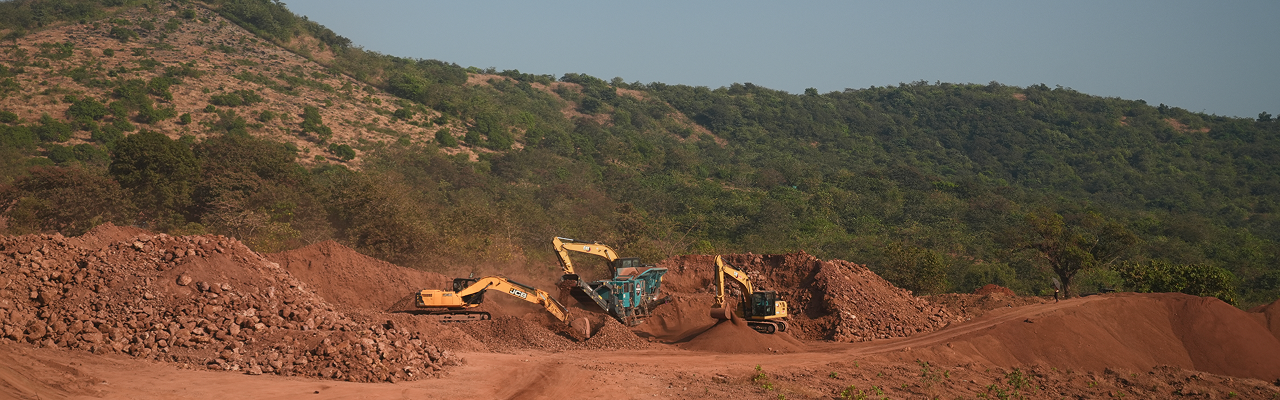

Mining is often defined by the subtraction of green cover. This view assumes the land was a thriving forest before the machinery arrived. However, when we look at the geological context of the Konkan belt, the reality is different. Here, the act of breaking the ground changes the ecosystem’s potential. With scientific precision, this process creates the conditions for richer vegetation to take root. To understand this, one must look at the land before the excavation begins.
The Geology of Exclusion
Much of the bauxite in this region sits beneath the Sada. These are vast, lateritic plateaus that define the Konkan landscape. These tablelands are geological antiques formed by millions of years of intense tropical weathering. This process leaches out silica and soluble nutrients. It leaves behind a concentration of iron and aluminum. The result is a “ferricrete duricrust.” This layer is rock-hard and impermeable. It often physically resembles a rusty metallic pavement
This geology dictates the biology. During the monsoon, the Sada supports a brief flush of ephemeral wildflowers and grasses. These species are adapted to shallow substrates and high water availability. However, this abundance is temporary. Once the rains recede, the water drains off the hard rock instantly. The plateau bakes in the sun for eight months of the year. The dense crust prevents tree roots from penetrating deep enough to access groundwater. The lack of topsoil means there are no nutrients to sustain perennial growth. It is a landscape of arrested development.
Mining as Deep-Tilling
This geological reality changes the context of our work. When we mine for bauxite, we perform deep-tilling on a geological scale. The extraction process shatters the impermeable duricrust. The removal of the mineral creates a void. We use this space to engineer a new ecological profile.
The process follows a strict protocol of horizon separation. Before we touch the ore, we strip the topsoil. This is the thin, nutrient-rich “skin” of the plateau. We store this separately from the overburden. It is treated as a biological asset rather than waste.
Once the ore is removed, the restoration begins. We fill the pit with the “overburden.” This consists of the softer lateritic clay and lithomarge that sat above the ore. We cap this with the preserved topsoil. This effectively solves the plateau’s oldest problem by creating soil depth
The Engineering of Fertility
The mechanical breaking of the rock creates porosity. Where the hard duricrust once forced water to run off, the new, aerated soil structure acts like a sponge. It absorbs and holds monsoon rainwater. For the first time, the land has a functional “root zone” capable of sustaining life through the dry season.
This anthropogenic intervention transforms a barren plateau into land capable of supporting deep-rooted species. We see the evidence in successful cashew and mango orchards on reclaimed mine sites across the region. These trees require deep soil to thrive. The reclaimed mine provides exactly that. These are productive, carbon-sequestering ecosystems. They provide economic value to local farmers in a way the original Sada never could.
The Chemistry of Sand
A similar logic applies to our silica sand operations, though the challenge there is chemical rather than physical. Pure silica is chemically inert. It has no “cation exchange capacity” (CEC). This means it cannot electrically hold the nutrients plants need. A plant in pure silica faces a desert-like environment regardless of water availability.
Our restoration protocol addresses this deficiency. Post-mining, we mix the remaining sandy substrate with organic amendments and clay. Clay particles carry a negative charge. This allows them to bind with nutrient ions. This mixture alters the chemical reality of the ground. It turns a sterile medium into fertile soil capable of supporting complex vegetation.
A Regenerative Standard Data from our closed sites points to a clear conclusion. Industry can be a mechanism for ecological improvement. We view our role as temporary custodians. We borrow the land, and we return it as a terraformed asset. In this specific geology, the machine that breaks the earth becomes the tool that heals it.